Showing posts with label review. Show all posts

6.27.2008

why hello!


Hello everybody, I'm back!

Yes, I have been on a bit of a hiatus from the pop-cult these days, but only officially. In spirit, I've been here all along.

A few things to catch up on:

-I finally got around to watching the first and second seasons of Battlestar Galactica, and all I can say is...frack ("fuck" in BSG lingo), this stuff is golden. But, you've all probably heard that before. My favorite elements of the show are kinda typical, but I can't help it. I just plain old love Mary McDonnell as President Roslyn. It's truly shameful that she hasn't gotten an Emmy nom yet. And Katee Sackhoff and Edward James Olmos are also dead-on as Starbuck and Adama, respectively. The show is smart, thrilling, and surprising. I found myself tearing-up during Season 1's "Flesh and Bone". What an unparalleled success this show has turned into. I'm in the middle of the Third Season, so don't spoil me...either of you.

- I also decided to heard over to the multiplexes to check out The Incredible Hulk, and I was not entirely impressed. To be 100% honest, I am not exactly an unbiased judge of comic book movies; I'm a huge Marvel fan. The comic book geek in me knows that TIH is a far more accurate and loyal adaptation of the comic's mythos, but I found myself longing for Ang Lee's bizarre stylings. There is evidently 70 minutes of character development strewn about the editing room floor, and I completely believe it. To tell the truth, I barely remember Edward Norton being in the film. He did what he could, but the film seemed to be bored with Bruce Banner, greatly favoring his green alter-ego. Tim Roth and Tim Blake Nelson were both fun as hell in their somewhat villainous roles, but I wish William Hurt had gone a little bit more over-the-top with Thunderbolt Ross. I know the studio wanted to erase memories of Hulk, but I really missed Sam Elliott's interpretation from that first film; he was the stand-out in that movie, and he would've really livened things up here. Overall: C+/C

- I'm going to go on record as being one of the few (sorta) proponents of The Happening. I'm not a fan of the characters, dialogue, or exposition, but the sheer cinematic bravado of the first half of the film was just breathtaking. I know that this is a very unpopular opinion, but I think critics dogpiled on the film because of Shyamalan's ego (which is very annoying, and still very present), but I think they missed the point of this project. The performances are terribly uneven, and the character development is laughable (John Leguizamo's character just plain makes no sense), but Mark Whalberg and Zooey Deschanel know when to go for laughs, and this redeems certain bizarre moments. M. Night could be one of the greats, but he needs to stop writing his own scripts. Concept work is fine, but he should definitely become more of a collaborator. Overall: B-

Nate

6.06.2008

Idi Amin had a funny eye


Watching Last King of Scotland (2006), I am struck with very mixed emotions.

On the one side, I feel the the film barely skims the surface of African identity, heritage, and life.

But, I am tempted to read the film as an anti-colonial narrative, with Idi Amin turning colonial practice against the British, and therefore, setting up an anti-British allegory. But to only use the country of Uganda and Amin's regime as a storytelling tool to criticize Britain degrades the worth and importance of Uganda as a country. Plus, how many movies depict multiple interracial romantic entanglements?

(BTW, Gillian Anderson looks like Virginia Madsen when she bleaches her hair.)

But, the hero still has to rely on the British, and then himself for rescue.

Sigh.

Ah, the travails of the modern day left-wing liberal film critic.

THAT SAID, both Forest Whitaker and James McAvoy are wonderful in this. McAvoy got a BAFTA nom, but was pretty much ignored otherwise. I am here to tell you that this is some horse-shit; McAvoy may be a pretty boy, but he also happens to be a great actor.

(Ultimately, I feel that the film is flawed, and deserves a B-, with the storytelling skills getting most of the credit. I still recommend a viewing. McAvoy and Whitaker each earn an A. Whitaker is awesome - truly awesome - but McAvoy has the harder task.)

Personally, I would list Whitaker as a Supporting Actor.

+++

Uh oh! Impromptu list time!

"PRETTY BOY" ACTORS WHO NEVER GET ENOUGH CREDIT

05. Jeff Bridges
He may not be as traditionally handsome as the other men on this list, but Jeff Bridges has been making acting look easy since he was born. With the one exception of the 1970s King Kong. Hasn't won an Oscar, and has only been nommed for one. But, c'mon, I mean...he was The Dude, dude.

04. Hugh Jackman
Bro played Liza Minelli's husband AND Wolverine convincingly, and totally carried The Fountain. Not to mention besting Christian Bale in The Prestige. Oscar nomination-less, Golden Globe nomination-less. However, he has won a Tony, and has hosted it multiple times.

03. Brad Pitt
I need only point at his cameo on Jackass, plus all of his film appearances as proof.

02. James Marsden
Listen. I've never disliked him, DESPITE the fact that he was given the absolutely shit role of Cyclops in the X-Men films. But his good-sport showing in Enchanted was enough to endear him to me. His sportsmanship in Hairspray is only additional.

01. Tom Cruise
Before you jump down my throat, admit this: Tom Cruise can be extremely charismatic in the right role. Magnolia tops my list.

Nate Tyson

PS: This is pretty funny.

My favorite is "When Obama wins...people will stop making bad remixes of Billy Jean."

My hypothetical contribution...

"When Obama wins...Chuck Norris jokes will be made illegal."

5.12.2008

It is YOUR Government...I suppose that is a small consolation


I watched Stephen Frears' The Queen earlier today, and I'm kicking myself for waiting so long to check it out. It is quite an interesting production, both artistically, and politically.

Obviously, Helen Mirren was fantastic, but I was equally taken with Martin Sheen's Tony Blair throughout the film. While Mirren was allowed a certain amount of artistic leeway - there are very little public preconceptions about the Queen's private demeanor compared to Blair's - Martin Sheen was given the role of a very public, over-scrutinized politician in his first week in office. Considering that the film was made and released toward the end of Tony Blair's political fall from grace - directly due to his support of Bush's War in Iraq - one can't help but see the depiction of Blair's early days as somewhat bittersweet.

In the film's last scene, Queen Elizabeth warns Blair that the British people will one day turn on him, without notice. Of course, we, as viewers, know that this has already happened. Over the course of the film, Blair is repeatedly accused of snuggling up to the establishment, despite his reputation as a reformer. This, along with that line of dialogue from Mirren's Queen Elizabeth, seem to create a second, sub-textual narrative to the film: The Tragic Fall of Tony Blair.

Looking for the script online, I discovered that the aforementioned line spoken by the Queen was NOT in the original script. Hmmm...this just leads me to believe that this sub-text was very purposefully established by Mr. Frears.

Nate

4.30.2008

...you are a runner, and I am my father's son

Oh lordy!

Why the blasphemous exclamation, you ask?

Well sir, I just got my hands on the new Wolf Parade LP, At Mount Zoomer. To paraphrase the infamous "Coast to Coast," I was so shocked, I almost dropped my glass of lemonade.

This album should definitely silence some haters who called shenanigans on their over-"indie-ness" on Apologies to the Queen Mary. This release is much more subdued, less bouncy, poppy stuff. They sound like a band moving their career forward, not a trendy flash-in-the-pan trying to maintain sub-cultural relevance.

And that is an undeniably good thing.

As for the songs, "Grey Estates" is an early favorite, but I'm only on listen number one. I should have more detailed thoughts soon.

Nate

PS:
Sub Pop's press release for the album is actually worth a look. I definitely think the claim that the album "never feels labored or fussy" is totally legit. This album is 100% less affected than their first LP, which I absolutely adore. But I have been known to love fussy art and entertainment.

PPS:
Sub Pop has the best corporate slogan I've ever seen: "We're not the best, but we're pretty good"

4.13.2008

Parnoid Park = Really Gay


In film class the other day, my insructor Lise was discussing the emergence of psycho-analytical film readings in the 1940s and 50s. She then mentioned that two of the fastest-growing areas film-studies: Queer & Colonial. In other words, we can look back at the filmographies of the geratest directors of all time and re-read these fims from a queer angle or from an anti or pro-colonial stance.

That said, I have always been a fan of a queer reading of cinema. Afterall, Hollywood has always been a little bit more densely populated by the gays than most other fields of work. So, I watched Paranoid Park tonight, and I am really psyched both that my streak of great films remains uninterrupted, and that I have a brand-new exmple of barely-disguised queer cinema to discuss.

So, Paranoid Park tells the story of a young skater who might've sorta killed a dude. Its directed by Gus Van Sant, and is apparently his first art film sicne completing the Death Trilogy (Elephant, Gerry, and Last Days). Now, I've loved Van Sant's Elephant since the film was released, I listed it as my favorite Van Sant film. However, after watching Paranoid Park, I would have to say that my mind has almost changed. And that is saying something.

Reading over the IMDb comments for the film, I immediately encountered a comparison to Camus' The Stranger. While the commenter specified that the film resmbled the book in tone not plot, I would argue the opposite. I would say that the film tells the basic story of The Stranger, except because the central characters are fundamentally different (the protagonist of Paranoid Park is not exactly nonchalant about the whole ordeal), we see the plot cut in half.

I think that the most apt reading of the film is with a homoerotic subtext. While Van Sant's film's have always embraced handsome male characters, much of his recent work (specifically this flm and Elephant) have employed androgynous male teens as the audience's surrogate, and this film especially seems to legitamize the queer subtextual reading of Van Sant's ouvre.

Where is the homoerotic subtext in this film you ask? Geez. Where to start? Well, the film's baby-faced main character is constantly day-dreaming about slightly older boys gliding through the air in slow motion, their backsides in special focus. Many times, these skateboarding reveries (shot on grainy handheld film, in the style of actual skate videos...an aesthetic that Van Sant wisely explores throughout the film) are accompanied by narration that can easily be read as a sort of sexual awakening. The young protagonst is constantly talking about his fascination and reverence of the older skate punks at Paranoid Park, and he dumps his girlfriend after she basically pressures him into having sex for the first time with her.

One scene that highlights the homoerotic subtext of the story in particular is approached in a Rashoman-like format. The first time we see it played through, we are introduced to a group of older homeless skate punks who seem to take a liking to our anti-hero Alex. After they invite him out "for some beers," one older guy seems to eye Alex with a predatory glance, and he explains that while he was unsure of drinking, he couldn't resist "jumping boxcars" with this handsome mysterious man.

The first time we see this scene played through, we immediately cut to a shot of Alex quickly undressing himself in an empty room, taking a shower, and then finding himself too emotonally distraught to call an unnamed somebody. It seem that this scene has been set up to lead the viewer to assume that a sxual liason has occured. However, later in the film, we learn that the strange gap in time actually contains the accidental murder at the plot's center.

So, if we were to just ignore the second edition of the scene, and acknowledge that SOMETHING happened in the boxcars between Alex and the handsome older gentleman, the murder becomes completely irrelevant...and the movie still works. Alex walks around with paranoia, shame, guilt, and ultimately a small relief, this could be the result of the discovery of his homosexuality if the context was tweaked just slightly.

The entire film, Alex discusses his girlfriend with a vague sense of disgust, and expresses to the audience through narration his extreme anxieties about the possibility that she may want to have sex with him. When they finally do have sex, she asks afterward "Should we do it again, or should we wait?" Alex just lies, expressionless on the bed.

These scenes play around with gender roles and expectations far too much to be ignored in any reading of the film, let alone a queer reading.

However, I would argue that a queer reading is really the dominant reading of the film. With the staggered plot progression - broken up by the film's narrative gimmick of having Alex be writing the story down as a confession - the murder and escape or over within a half-an-hour into the film. The real meat of the film lies in Alex's face, which must take up about 88% of the film's running time. Van Sant has the camera study Alex's blank face the same way Bergman observed Ullman's in Persona.

To be clear, I am in no way implying pedastray - on the contrary, I find Van Sant's treatment of of Alex to be far from exploitative - but I would definitely argue that the film's fascination with the physical nature of skateboarding, paired with the somewhat allegorical homoerotic reading of the film, cannot be ignored when assessing its direct meanings.

In the end, Van Sant continues to be one of the most worthwhile modern directors to get invested in, rain or shine. In this case, the sun is almost brighter thn ever,

Nathaniel Tyson

4.06.2008

Charlie Kauffman, fat and bald speaks into a tape recorder: "Charlie Kauffman, fat and bald speaks..."


I had a read-through of my sketch/play today. It is currently titled 3 Teachers, but who knows what that will end up being after all is said and done. I wrote the script for the new play festival here, but I might end up keeping a couple of the characters I wrote for other stuff. Or maybe I'll write more stuff about a couple of them. Who knows.

+++

Rewatching Adaptation. last night, I was struck by just how difficult it is to figure out the exact trajectory of the screenplay.

Evidently, this film is what Kauffman turned in when he was given the real-life assignment to write a film version of The Orchid Thief. But we all knew this back in 2002, when I originally saw the film. It is generally accepted that the real transition of the film occurs between the second and third act, after Kauffman has attended McKee's lecture and Charlie's imaginary twin brother and hack screenwriter Donald has joined him in New York. At this point, the film dissolves into all the conventions and cliches that Kauffman had been struggling to avoid using the entire time.

But my question is this: how did Donald come around as a concept at all? Did Kauffman write his meta-adaptation and then revise it to include Donald, or was Donald an original part of the story. I doubt it, considering that Kauffman is not a part of the original story. I also wonder if Kauffman actually attended a McKee seminar while writing this movie. If he did, that makes this whole thing that much better.

Ultimately, Adaptation. is both a denial and a justification of Kauffman's refusal to "write a simple story." When he does, it is the grotesque third act of the film, but it is that third act that propels the screenplay into genius territory. So Kauffman both mocks and indulges in all the typical cinematic cliches, and we get Mery Streep, Nicolas Cage, and Chris Cooper at the top of their games? Plus cameos from Maggie Gyllenhaal, Tilda Swinton, and Catherine Keener? Maybe I was a little harsh on this one at first.


Nathaniel Tyson

Superman does good, you do well


I had a bit of a movie binge today, and watched Margot at the Wedding and rewatched Adpatation., along with starting up a complete viewing of 30 Rock in its entirety (inspired by my recent enjoyment of Mean Girls.

Margot at the Wedding is a less effort than director/writer Noah Baumbach's last movie, The Squid and the Whale, but that is not necessarily that negative a comment. Where The Squid and the Whale excelled was the effortless cohesion among the actors, director, and script. While Margot has its excellent elements (especially Nicole Kidman and Jennifer Jason Leigh, both of whom were fantastic...but more on that in a moment), it strikes some distractingly off-key notes at times.

While I am actually a Jack Black fan usually (shameful in most circles), I think he's miscast and hammy in here. In fact, his character seems to be written as a completely different character than Black is playing. The young actors also leave much to be desired. The boy (I just don't feel like looking up his name) has an expressive enough face, but little emotive ability besides that. John Tuturro's cameo is welcome and nuanced, and he plays excellently against Black and Kidman (it's Black's best scene in the film).

Now, on the subject of Nicole Kidman...I just wish the God she would choose projects as good as this all the time. She is absolutely amazing in this. Really wonderfully layered and playful work, and never over-the-top or flashy. No really, not even for a second. There's this wonderful moment in the final scene in which you think she is about to break down into the emotional catharsis of the film, but one comment from her son quickly snaps her back into her vicious, defensive self. It's a tricky moment that Kidman pulls off flawlessly. It's really a shame she's out of fashion, because she would have been a deserving nominee in February. In fact, I might go as far as to say that she deserved the trophy. But mind you, I'm a little under-viewed for 2007.

Down to the thematic stuff. Like his colleague Wes Anderson, Noah Baumbach obviously has his influences, and wears them on his sleeve. The son of two film critics, it's easy to see how Baumbach ends up making "critic-friendly" films; but I think that it's unneceessary to discount him for this. Where Baumbach succeeds, and Anderson fails, however, is in the exploration of their particular cinematic and thematic fetishes. Margot is pretty clearly the same character that Laura Linney played in The Squid and the Whale, but while this sort of redundant character work bothers me in Anderson's films (look at the characters he writes for Anjelica Huston), Baumbach plays with real characters, not story-book cut-outs. The long family history that is hinted at in Margot seems to fit with the random details of The Squid and the Whale, so it's tempting (and perhaps correct) to assume that both films are somewhat autobiographical, and that Baumbach is exorcising some family demons with these films. But we all knew that.

Baumbach Cinematic Themes: the official list
incest (both oedipal and otherwise)
feminine teenage boys
strange attachment to emotionally-damaging parental figures
divorce
family secrets
fathers/husbands screwing around with young girls
competing intellectual parents
mom's who fuck around with other men and deny any emotional intimacy to the rest of their family
siblings taking sides in divorce

Yeah, you get the picture. White people stuff.

Question for Baumbach fans: do you think Margot's son is the parallel to the older or younger son in Squid and the Whale? My bet is that this is a younger version of the older son. The behavior is similar but not quite exactly like the younger son, but it seems to be set before the couple's break-up. I mean, this is all presumptuous, but I think it's kind od a clear connection between the families in the two films.

Nate

3.31.2008

Danny DeVito! I love your work!

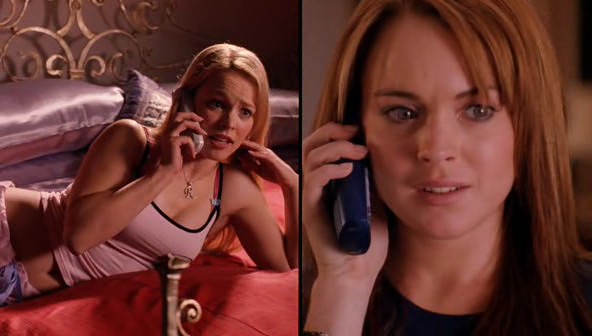
I rewatched Mean Girls this afternoon, and I am definitely happy to have returned to the world of the Plastics after a few years time. I'm happy to report that Mean Girls not only holds up nicely, but seems to have gotten more approprate with age. The ultitimate message of the film (that the only thing worth spending your energy on is being an "actual human being") is not just universally positive, but also a very topical message for this decade of gossip websites and willful hihilism and superficiality.
I miss Lindsay from the pre-going crazy movies, like this. She was a damn fine actress.


I also recently watched Southland Tales, Richard Kelly's oft-delayed and maligned follow-up to Donnie Darko, and I'm confused as to why it has gotten such vehemently negative reviews so far. The film is a mess, clearly, but the worst aspects of it [the overlong prologue, the under-developed plotlines, and Cindy's truncated character arc] were obviously forced upon Kelly by the studio (see a partial history of the troubled making and editing of the film here). Otherwise, the film is a fascinatng,jumbled sci-fi comedy that bit off just a bit more than any film could possibly chew. The cast is uneven, but in a wonderfully silly way that doesn't distract from the film's hodge-podge aesthetic. Sean William Scott is the stand-out, but Dwayne Johnson, Justin Timberlake, Sarah Michelle Gellar, and Mandy Moore are all given chances to stretch and play around with their public and screen personas.
The plot of the film is purposefully convoluted and frustrating, but it is nowhere near as obtuse as Darko's vague, ominous portentousness. But, truthfully, I miss the consistency of Darko, which was an extraordinarily well-orchestrated debut.
I need to watch the film again and write something a little longer than this.

Nathaniel Tyson

3.03.2008

Recent music thoughts...


Deadly Avenger - Blossoms & Blood
Some sweet-ass electronica that a man can really get behind. I don't know enough about the genre to sy much else, but I definitely recommend checking this one out if you like the idea of music that computers make love to.

The Dodos - Visitor
This album was initially described to me as having been created just for those who believe that Animal Collective's Sung Tongs is a thing of rare beauty and genius. I happen to believe this, so I can only discuss The Dodos as an Animal Collective fan. The instrumentation and vocals are certainly reminiscent of 2004 AC, but the spirit is different. The voice reminds me of Beirut's Zach Condon, rather than either Avey Tare or Panda Bear, but this isn't necessarily a bad thing. The Dodo's are a more traditional song-writing duo, but this leads them to streamline AC's tics and idiosynchratic elements into polished pop. Good stuff, but not great.


Earth - The Bees Made Honey in the Lion's Skull
These guys are evidently a very influential metal act from Seattle that's been around since 1990. Couldn'tve proven it by me. I came into this album with no prior knowledge of Earth or their influence. According to some sources, this album is very different then their earlier, harder material. But here's what it breaks down to: The Bees Made Honey is basically a great prog album to get high and space out to. Made up of seven longish tracks, the album is perfectly paced for its length; the songs never seem to rush to where they're trying to go. I'm a burgeoning fan of spacey instrumental metal, and this album delivers the goods on that front. Definitely recommended. Strongly.

Los Campesinos! - Hold on Now, Youngster...
Self-referential, sweetly sincere twee that doesn't aim to stand above the scene, but instead revels in it. While the gimmicky nature should wear thin, the band's charming sarcasm is enough to support an entire LP.


The Mountain Goats - Heretic Pride
This is, in my eyes, the first album to break Darnielle's streak of greatness since 2004's We Shall All Be Healed. The album starts out strongly with "Sax Rhomer #1" and the fantastic "San Bernardino", but clunkers like "So Desperate" and "Autoclave" are shockingly generic and uninteresting. The second half of the album picks back up, but I'm not certain it's enough to save the entire LP. This may be the least consistent record Darnielle has made in half a decade. However, that said, it's definitely worth a listen for the good stuff.

Vampire Weekend - s/t
Good, catchy rock. You and I are going to be sick of them very soon, if you already aren't. I am, kinda. Favorites are "Walcott" and "Oxford Comma".

++++

I have shuffled up and begun numbering my recommended section. You can always access that section from the sidebar under "2008's Recommended Stuff". I really need to get out and see some movies, don't I? Hopefully, I'll finally get a chance to see Be Kind, Rewind sometime soon.

I have some other records that I need more time with before writing-up.

On a related note, I finally heard the new Gnarls Barkley single, "Run". You can hear it at this seemingly fake Myspace profile. It's quite good, really. However, Luke and I both noticed something strange about it. Check the 1:30 mark...Cee-Lo sings the line "I have got a beast at baaaay". Do his vocals remind you of anyone? Tenacious D, perhaps? The entire song is totally a rip-off of "Master Exploder" from the Pick of Destiny. Oh DJ Dangermouse...did you think nobody would notice?

Nathaniel Tyson

2.29.2008

Tell him that Omar says that Marlo is not a man for this city


I am officially two episodes away from the end of the fifth season of The Wire.

There are only two episodes of The Wire, in exsistence, that I haven't seen.

I'll miss it more than any other TV show I've ever watched. Even more than Buffy, Arrested Development, Freaks and Geeks, and Clarissa Explains it All combined.

The fifth season has been far, far too short, but the writers have done their best to wrap-up a show that has always flaunted its disdain for tying-up loose ends. The season's central story arc is shorter and less intricate than the other seasons' have been, but the absence of a new major police investigation (replaced this season by McNolte's serial killer) allows for the writers to make brief forays into the rich history of minor characters the show has introduced over the course of four seasons. One of my favorite examples of this occurs when Bunk ends up questioning an older, angry Randy Wagstaff, who has made clear progress toward ridding himself of his snitch label by adopting a confrontational, agressive persona. Between this season the fourth, Randy has become as unknowable and foreign to Bunk (and the audience) as every other hopper on the corners of Baltimore.

This short glimpse of a sad fade out is the farewell chosen for many of the series' peripheral characters, as we can also see in Nicky Sobotka's impotent protesting of Carcetti's pet project, the gentrification and demolition of Baltimore harbor's port system, and in Omar's casual murder of Savino, a former Barksdale muscle who switched loyalties to Marlo out of simple necessity and survival.


Two episodes shy of the finale, I can say that I fear for McNulty, who seems destined to prove one of the The Wire's more cynical codas ( that long-established social institutions will easily control most people, and ultimately destroy those who try to operate outside of them) correct. Like Stringer Bell, Bunny Colvin, and Prop Joe before him, McNulty's manipulation of the bureaucratic machine he operates within may prove to be his downfall. Stringer's attempts to reshape the Baltimore drug trade as a non-violent open market environment were undermined by his own moral failings, some of which lead to his assassination. McNulty's plan to redistribute the city's major crime budget with a fictionalized serial killer is similarly undermined by McNulty's own delusions of grandeur and deeply-buried insecurities about his own intelligence and worth to the department. While I don't see a shotgun blast to the chest in Jimmy's future, I'm not sure the likely alternative is much better.

Well, I'm off to watch #9, and then last night's Lost. Steve told me that it has been called one of the best episodes ever. Steve is capable of exaggeration, but I want to believe this too much to not get excited. I also want to watch 4 Months, 3 Weeks, and 2 Days sometime this weekend, but I have a lot of general life stuff that I really need to take care of first.

Jeez. Real life. Always getting in the way of the really important things, no?

Nathaniel

1.28.2008

I wanna look out the window of my color TV


Sometime during the middle act of Cloverfield, the main character runs into a currently-being-looted electronics store to get ahold of a new phone. As New York City burns to the ground around them, several people stare in stunned silence at the televisions in the store displaying footage of the thirty-story tall monster. Less than two minutes later, the camera leaves the store and reveals to the audience that the very newsreport that many had stood silent to watch is occuring literally down the block.

This scene is the moment I will always point to when I talk about Cloverfield. Whether literal or not, this scene works as the thesis of Cloverfield, a monster movie for 2008: less concerned with its own monster, instead focusing on how people's natural survival instincts have become secondary to the comfort that the documentation and digestion our world through images and sound provides us.

When Marshal McLuhan declared that "the medium is the message", he was stressing the oft-overlooked effect that communications media can have on our subconcious. According to McLuhan, the direct message being delivered can sometimes have a less meaningful effect than the media through which it is being delivered. In this theory, our rational and intelligent mind engages with the overt signals sent to us, but the subliminal influence on our subconciouses poses a more dire, less protected-against threat.

Surely, J.J. Abrams is familiar with McLuhan's work, which leads me to give him the benefit of the doubt in regards to the flimsy story all this media-pontificating decorates.

Of course, this is surely not the only thought driving Cloverfield, but that is what is so nice about the film, it is a monster movie that aquits itself well to multiple readings. On the surface, Cloverfield is a popcorn epic with a small twist: the entire movie is shot on handheld camera, being operated by one of the main characters. 1st person narrative films are usually considered somewhat gimmicky (and they usually are), but this small change in detail transforms the concept of Cloverfield from action film into a fascinating cultural study. The film is not so much worried about explaining the monster attacking New York City or blowing up cars as much as it is enraptured with the bizarre reactions human beings have to large-scale panic.

Unfortunately, this strength ultimately contributes to Cloverfield's weakest element: the story. While I applaud J.J.'s tactful, classy take on a "everyone dies" monster movie, the film could have used more actually affecting human emotion in its narrative. The rush we feel upon the monster's epic entrance earns enough goodwill for 45 minutes or so, but the rest of the film drags in comparison. I blame this on the lack of attention to the actual plot of the film. While the search-and-rescue story provides plenty of chances to see various portions of a destroyed New York, the sheer stupidity of it makes for a frustrating film. I assume that the characters are purposefully borderline-dislikable (they represent what one critic called the 9/11 yuppies, or the arrogance of NYCers who weren't present for the tragedy), but far too much time is spent unsuccessfully reaching for audience sympathy for one-dimensional characters. Abrams may have fared better if he had taken his character's symbolic nature all the way and excluded any unnecessary exposition from the movie. This all said, however, I managed to enjoy the film's brainy center despite the bland cookie shell.

The video camera as viewer trick aside, modern media consumption is a major thematic focus in Cloverfield. When the Statue of Liberty's head comes rolling right down the street, the dazed citizens stare in shock and confusion...and then quickly whip out their phones the get a picture of it. This need to document distaster (also seen in the fact that for some reason, our protagonist refuses to drop the stupid camcorder) has become a prevelant trend in America since someone got footage on their shitty little camera of someone flying a plane into the World Trade Center. This is what makes Cloverfield special: it's not about the monster, it's about the people REACTING to the monster, numbing themselves by putting up some sort of lens to seperate themselves from the terror around them.

While I have a moment, I might as well declare this to be one of my favorite films dealing with September 11th, with the caveat that I have avoided almost all movies more directly focused on the events.

Nathaniel Tyson

PS:

Thanks to my lovely Politics of Pop Culture professor, Susana Loza, I have become aware of one of the best websites to have ever been conceived: Stuff White People Like. The picture of sushi on the page's banner won me over instantly.

While I do admit that I feel somewhat in-on-the-joke, this entry is a definite reminder of just how disappointingly stereotypical I can be.

PPS: I don't grade films, by the way, but if you're the kind who reads reviews as thumbs-up/thumbs-down, I recommend it with some hesitation.